

Verbs that start with C are some of the most powerful action words in English. They cover everything from physical movement to deep emotion to professional achievement. Whether you call someone, create something new, or communicate a complex idea — C verbs carry real weight. This guide covers 150+ verbs organized by purpose, helping students, writers, and word-game players find exactly the right word fast.
Quick List: Top 10 Most Useful Verbs That Start With C
Here are the 10 C verbs that show up everywhere — in writing, resumes, school, and daily conversation:
- Call — to reach out or name something
- Create — to make something new
- Change — to shift from one state to another
- Carry — to move something from place to place
- Choose — to pick between options
- Connect — to link two or more things
- Control — to manage or direct something
- Communicate — to share information or feeling
- Continue — to keep going without stopping
- Construct — to build something deliberately
These ten power most everyday writing. The deeper value comes from knowing when to go beyond them.
Categorized Verbs That Start With C Groups
Every verb in this guide appears exactly once — in the group where it fits best. No repeats across sections.
Group 1: Physical Action Verbs That Start With C
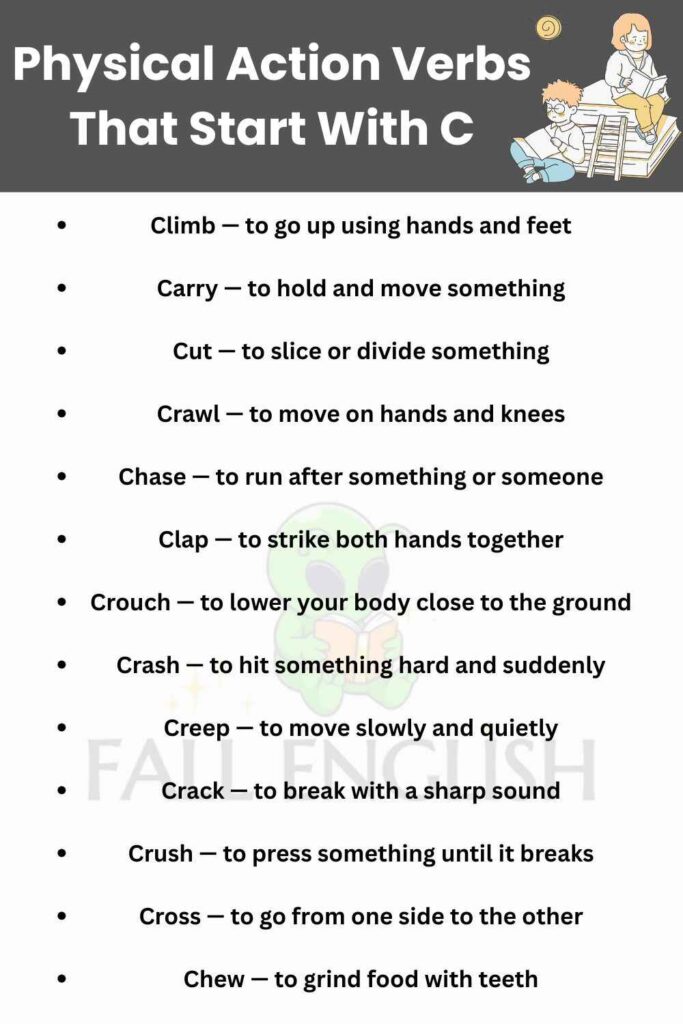
These describe what the body does. Great for storytelling, sports writing, and active descriptions.
- Climb — to go up using hands and feet
- Carry — to hold and move something
- Catch — to grab something moving through the air
- Cut — to slice or divide something
- Crawl — to move on hands and knees
- Chase — to run after something or someone
- Clap — to strike both hands together
- Crouch — to lower your body close to the ground
- Crash — to hit something hard and suddenly
- Creep — to move slowly and quietly
- Crack — to break with a sharp sound
- Crush — to press something until it breaks
- Cross — to go from one side to the other
- Chew — to grind food with teeth
- Curl — to form a curved shape
- Collide — to crash into another object or person
- Clutch — to grip something very tightly
- Clamber — to climb awkwardly using hands and feet
- Careen — to move fast and completely out of control
- Clatter — to make a sharp rattling noise while moving
- Clasp — to hold something firmly with the hand
- Crane — to stretch your neck forward to see something
- Convulse — to shake violently and without control
- Claw — to scratch or dig using fingernails or claws
- Clench — to squeeze tightly, especially fists or teeth
- Coast — to move forward without effort or power
- Coil — to wind something into a circular shape
Here’s the catch — many writers use “hold” when they mean “clutch.” These are not the same. Clutch carries urgency. Hold is neutral.
Group 2: Communication Verbs That Start With C
These describe how people share ideas, feelings, and information.
- Call — to speak to someone or give something a name
- Communicate — to share ideas or information clearly
- Confess — to admit something true, usually difficult
- Clarify — to make something easier to understand
- Confirm — to state that something is true
- Convince — to make someone believe something
- Consult — to ask for expert advice
- Complain — to express unhappiness about something
- Comment — to say something about a topic
- Chat — to talk in a relaxed, casual way
- Counsel — to give advice to someone in need
- Confront — to face someone about a difficult issue directly
- Claim — to state something as true
- Correct — to fix what is wrong
- Caption — to write a description under an image
- Correspond — to exchange messages with someone over time
- Convey — to express a meaning or feeling to another person
- Counter — to respond to something with an opposing point
- Concede — to admit that something is true after resisting it
- Contest — to formally challenge a decision or statement
Most people miss this: clarify and explain feel similar, but clarify is stronger when someone is already confused. Explain works better when teaching something completely new.
Group 3: Emotional and Abstract Verbs That Start With C
These reach into the inner world. Use them in personal essays, fiction, and poetry.
- Care — to feel concern for someone or something
- Cherish — to hold something deeply precious over time
- Crave — to want something with intense desire
- Comfort — to make someone feel better during hard times
- Contemplate — to think about something slowly and deeply
- Confide — to share a private thought or secret with someone
- Console — to ease someone’s sadness or grief
- Cope — to manage something difficult without breaking down
- Commit — to make a serious and lasting promise
- Cling — to hold onto something emotionally, even when it hurts
- Crumble — to fall apart emotionally or physically, piece by piece
- Captivate — to hold someone’s complete and willing attention
- Covet — to deeply want what someone else has
- Calm — to bring peace to someone or a situation
- Concern — to cause worry or unease in someone
- Condone — to accept or allow something without objection
- Condemn — to express strong disapproval of something
- Conceal — to hide something from others intentionally
- Coerce — to force someone to act against their own will
Quick tip: Use cherish when the feeling runs deep over time. Use love for everyday warmth. In serious writing, that distinction matters more than most people realize.
Group 4: Academic and Professional Verbs That Start With C
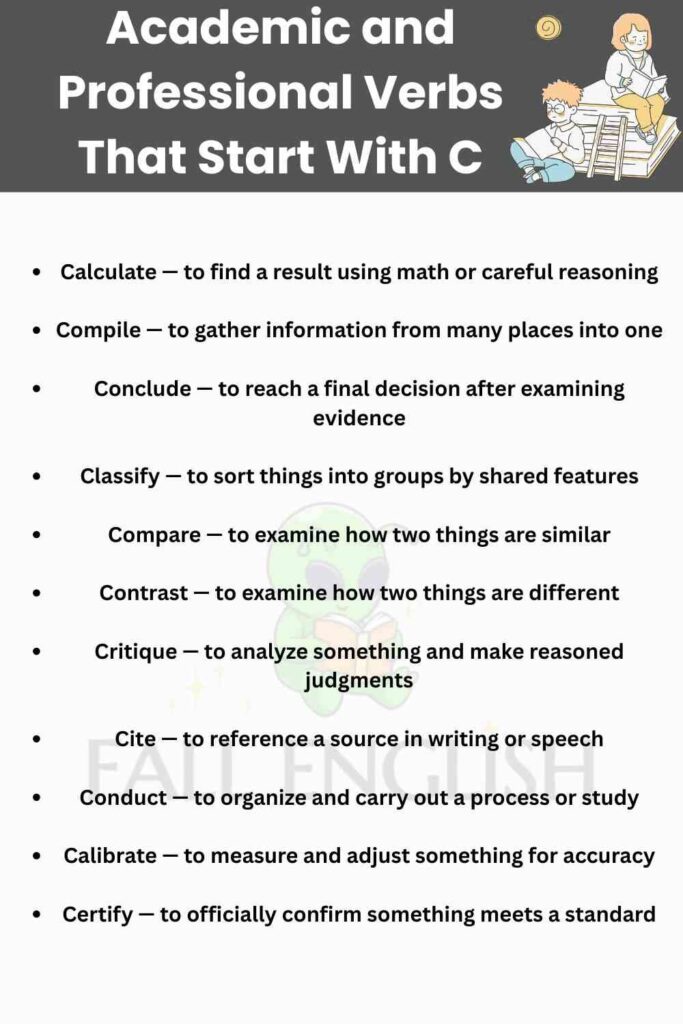
Researchers, writers, and business professionals use these daily.
- Calculate — to find a result using math or careful reasoning
- Construct — to build something with planning and precision
- Compile — to gather information from many places into one
- Conclude — to reach a final decision after examining evidence
- Classify — to sort things into groups by shared features
- Compare — to examine how two things are similar
- Contrast — to examine how two things are different
- Critique — to analyze something and make reasoned judgments
- Cite — to reference a source in writing or speech
- Conduct — to organize and carry out a process or study
- Calibrate — to measure and adjust something for accuracy
- Certify — to officially confirm something meets a standard
- Chart — to map out information or progress visually
- Consolidate — to combine separate parts into one unified whole
- Conceptualize — to form a clear idea or mental model of something
- Contextualize — to place something within its broader situation
- Characterize — to describe the defining qualities of something
- Circulate — to pass information or documents through a group
- Compensate — to make up for something with equal value
- Comply — to follow rules, instructions, or requirements
Note this: Many students confuse compare and contrast. In academic writing, compare focuses on similarities, contrast on differences. Strong essays usually require both.
Group 5: Positive and Growth Verbs That Start With C
These are the verbs that build, encourage, and move things forward. These are the positive verbs that start with C that readers search for most.
- Create — to produce something that did not exist before
- Cultivate — to grow something valuable with patience and care
- Contribute — to give something meaningful to a shared effort
- Challenge — to push past current limits toward something better
- Champion — to actively stand up for a person or cause
- Celebrate — to honor an achievement or special moment with joy
- Coach — to guide someone steadily toward their best
- Cheer — to lift someone’s spirit with words or energy
- Complete — to bring something through to its full finish
- Collaborate — to work alongside others, each adding their own strength
- Change — to grow beyond what you were before
- Choose — to take ownership of your own direction
- Connect — to build a real and lasting bond with someone
Group 6: Phrasal Verbs That Start With C
Phrasal verbs carry meanings that the base verb alone does not. Each one here is listed only in this section.
- Carry on — to continue doing something despite difficulty
- Call off — to cancel something that was already planned
- Come across — to find or encounter something unexpectedly
- Cut off — to stop something suddenly or interrupt someone
- Catch up — to reach the same level or pace as someone else
- Check in — to confirm arrival or make brief contact
- Check out — to leave a place or examine something closely
- Count on — to trust or depend on someone fully
- Come up with — to think of a new idea or solution
- Cut down — to reduce the amount or frequency of something
- Calm down — to become less upset, anxious, or excited
- Close in — to move steadily nearer, often in a threatening way
- Cover up — to hide something from others deliberately
Resume and Business Verbs That Start With C
The verb you pick in a resume bullet tells the hiring manager exactly how significant your role was. These verbs do not appear in any earlier section.
- Coordinated — Coordinated a cross-functional team of 12 to deliver a product launch on schedule
- Conducted — Conducted quarterly performance reviews for 20+ staff members
- Compiled — Compiled monthly financial reports distributed to senior leadership
- Chaired — Chaired weekly operations meetings across three regional departments
- Controlled — Controlled a $500K annual budget with consistent zero overspend
- Converted — Converted cold leads into paying clients using a custom outreach sequence
- Configured — Configured CRM software workflows for a sales team of 40
- Championed — Championed a customer feedback program that improved retention by 18%
- Created — Created a staff training program that cut onboarding time by 30%
- Certified — Certified in Google Analytics, overseeing tracking across five brand properties
- Consolidated — Consolidated three separate reporting databases into one unified system
- Collaborated — Collaborated with legal, compliance, and product teams on policy updates
Quick tip: Never open a bullet with “Responsible for.” It is passive and forgettable. Always lead with the verb.
Creative Writing — Swap These Weak Verbs for Strong C Verbs
Strong fiction lives in its verbs. Here are swaps that immediately sharpen your sentences — using C verbs not yet covered above:
| Weak Verb | Strong C Verb | Why It Works Better |
| Said quietly | Confided | Adds secrecy and emotional closeness |
| Moved without stopping | Careened | Suggests dangerous speed and loss of control |
| Shook badly | Convulsed | Stronger, more physical, more alarming |
| Held tightly in hand | Clasped | More deliberate, more tender than gripped |
| Looked and stretched neck | Craned | Shows physical effort and desperate curiosity |
| Scratched hard at surface | Clawed | Rawer, more desperate, more primal |
| Squeezed fists tight | Clenched | More specific — jaw, fist, teeth all work |
| Fell apart piece by piece | Crumbled | Slower, sadder, more emotionally resonant |
The difference between a story people remember and one they forget is almost always the verbs.
Simple Verbs That Start With C for Kids and Beginners
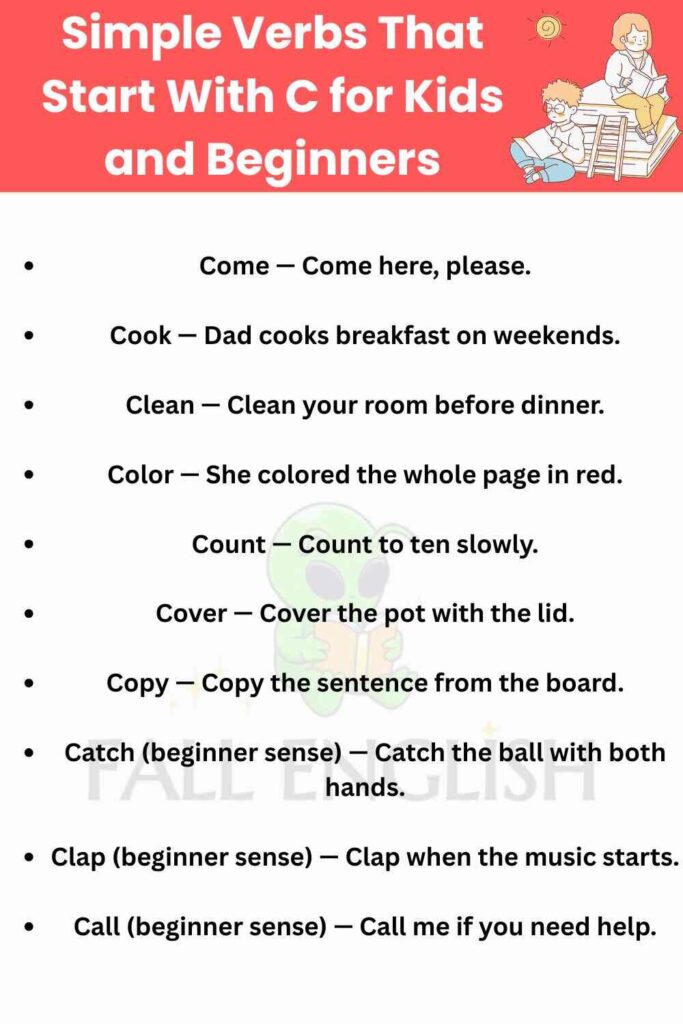
These are beginner-level verbs — short, common, and easy to spell. They do not overlap with any verb already listed above.
- Come — Come here, please.
- Cook — Dad cooks breakfast on weekends.
- Clean — Clean your room before dinner.
- Color — She colored the whole page in red.
- Count — Count to ten slowly.
- Cover — Cover the pot with the lid.
- Copy — Copy the sentence from the board.
- Catch (beginner sense) — Catch the ball with both hands.
- Clap (beginner sense) — Clap when the music starts.
- Call (beginner sense) — Call me if you need help.
Hard C vs. Soft C — Quick Explanation:
This trips up a lot of beginners.
- Hard C sounds like /k/ — cat, cup, coat, clock
- Soft C sounds like /s/ — celebrate, circle, cite, cycle
Simple rule: When C comes before e, i, or y, it usually makes the soft /s/ sound. Before any other letter, it is hard /k/. That is the whole rule.
Modern and Tech Verbs That Start With C (2026)
These are newer verbs showing up in workplaces, digital content, and tech conversations right now. All are unique to this section.
- Code — to write instructions that a computer can read and run
- Cloud-source — to store, access, and share files through cloud platforms
- Copy-paste — to duplicate digital content from one location to another
- Code-switch — to shift naturally between languages or communication styles
- Crowdsource — to gather contributions, ideas, or funding from a large online group
- Cross-post — to share identical content across multiple platforms at once
- Compress — to reduce a file’s size without losing its essential content
- Cache — to store data temporarily so it can be accessed faster later
- Cryptocode — to protect data using encryption and cryptographic methods
- Curate — to carefully select and arrange content for a specific audience or purpose
Content that uses current language ranks better because it reflects how people actually search and speak today.
Master Verbs That Start With C Reference Table
This table covers key verbs from across the guide — useful for quick reference, academic work, and writing decisions.
| Verb | Past Tense | Synonym | Best Use Case |
| Capture | Captured | Seize | Emotional writing, photography, tech |
| Confront | Confronted | Face | Fiction, conflict, difficult conversations |
| Cultivate | Cultivated | Develop | Personal growth, long-term relationships |
| Clarify | Clarified | Explain | Teaching, professional emails |
| Conceal | Concealed | Hide | Fiction, character motivation |
| Circulate | Circulated | Distribute | Academic, office communication |
| Compensate | Compensated | Make up for | Legal, HR, business writing |
| Conceptualize | Conceptualized | Envision | Design, strategy, planning |
| Comply | Complied | Follow | Legal, regulatory writing |
| Calibrate | Calibrated | Adjust | Science, engineering, tech |
| Contest | Contested | Challenge | Legal, debate, academic argument |
| Concede | Conceded | Admit | Debate, negotiation, academic writing |
Verbs That Start With C by Word Length
For word games, puzzles, or when you need a specific letter count — here are C verbs grouped by length. This section references all verbs from the guide for quick scanning.
3-Letter C Verbs:
- Cap, Cup, Cry, Cue, Cob
4-Letter C Verbs:
- Cast, Cave, Clam, Clip, Club, Coin, Comb, Come, Cook, Copy, Curl, Curb, Cuss
5-Letter C Verbs:
- Carry, Catch, Chase, Check, Cheer, Climb, Close, Coach, Count, Cover, Crack, Crash, Crawl, Crush, Claim, Craft, Crave, Crimp, Croon
6-Letter C Verbs:
- Cancel, Charge, Change, Choose, Circle, Combat, Comply, Confer, Create, Censor, Compel, Canvass, Coerce
Long Verbs (8+ Letters):
- Calculate, Captivate, Celebrate, Circulate, Collaborate, Communicate, Compensate, Compromise, Configure, Consolidate, Contemplate, Contribute, Coordinate, Correspond, Counteract, Characterize, Contextualize, Conceptualize, Concentrate, Corroborate, Commercialize, Circumstantiate
Common Confusions about C Verbs
These mix-ups show up constantly in student writing, business emails, and even published content.
Cite vs. Site vs. Sight
All three sound nearly identical. Only one is a verb in standard use:
- Cite — verb — to reference a source (Cite your evidence clearly.)
- Site — noun — a location or web address (Visit the site for details.)
- Sight — noun/verb — to see or spot something (They sighted land at dawn.)
Compare vs. Contrast
Both are academic verbs, but they point in opposite directions:
- Compare — finds similarities between two things
- Contrast — finds differences between two things
Most academic prompts ask for both. Do not use only one and assume you have done the other.
Convince vs. Persuade
Close in meaning, but not interchangeable:
- Convince — changes what someone believes
- Persuade — changes what someone does
You convince someone of a fact. You persuade them to act on it.
Complement vs. Compliment
Both can be verbs. Both can be nouns. The spelling makes all the difference:
- Complement — to complete or pair well with something (The sauce complemented the dish.)
- Compliment — to say something kind (She complimented his presentation.)
Coerce vs. Convince
These are not synonyms, though people treat them that way:
- Coerce — to force someone through pressure, threats, or power
- Convince — to bring someone to agreement through reasoning
One removes choice. The other respects it.
How One C Verb Means Five Different Things
Take the verb capture. Same spelling. Completely different meanings across fields:
- Photography: To capture an image — take a photo worth keeping
- Chess: To capture a piece — remove your opponent’s piece from the board
- Software: To capture data — record and store incoming information
- Creative writing: To capture a feeling — describe an emotion so precisely that readers feel it themselves
- Military history: To capture territory — take physical control of a location
One word. Five worlds. That is what makes C verbs so worth studying carefully.
Real Writing Insight on Verbs That Start With C
For a long time every sentence I wrote leaned on the same handful of verbs: make, get, go, put, take. Safe. Forgettable.
The shift came when I started asking a different question. Not “what verb works here?” but “what verb is true here?”
“He made his way through the crowd” became “He carved through the crowd.”
“She got what she wanted” became “She claimed exactly what she came for.”
Nothing got longer. Everything got sharper. The right verb is not decoration — it is precision. Most weak writing is not a grammar problem. It is a verb problem.
Weak vs. Strong — Word Choice in Action
| Weak Version | Strong Version | Why the Strong Version Wins |
| He said the answer quietly | He confided the answer | Adds secrecy and trust between people |
| They came together from different cities | They converged | One precise word replaces seven |
| She cried in front of everyone | She crumbled in front of everyone | Crumbled is physical and emotional together |
| He moved through the door carefully | He crept through the door | Crept shows stealth, intention, and tension |
| She got their attention immediately | She commanded the room | Commands power and presence without extra words |
Mini Quiz — Pick the Better C Verb
Question 1:
Which sentence is stronger?
A) He admitted he was wrong. B) He conceded he was wrong.
✅ Answer: B Conceded carries the weight of resistance overcome. It tells you the admission cost him something. Admitted is flat by comparison.
Question 2:
Which verb fits best?
She _______ years of doubt into a single confident decision.
A) changed B) converted
✅ Answer: B — converted Converted shows transformation — one thing becoming something entirely different. Changed is too general to carry that specific meaning.
Question 3:
Best opening for a resume bullet?
A) Was in charge of compiling reports. B) Compiled weekly performance reports for senior leadership review.
✅ Answer: B Direct. Past tense. Specific. The verb comes first and does the work immediately.
Full Master List: 150+ Verbs That Start With C
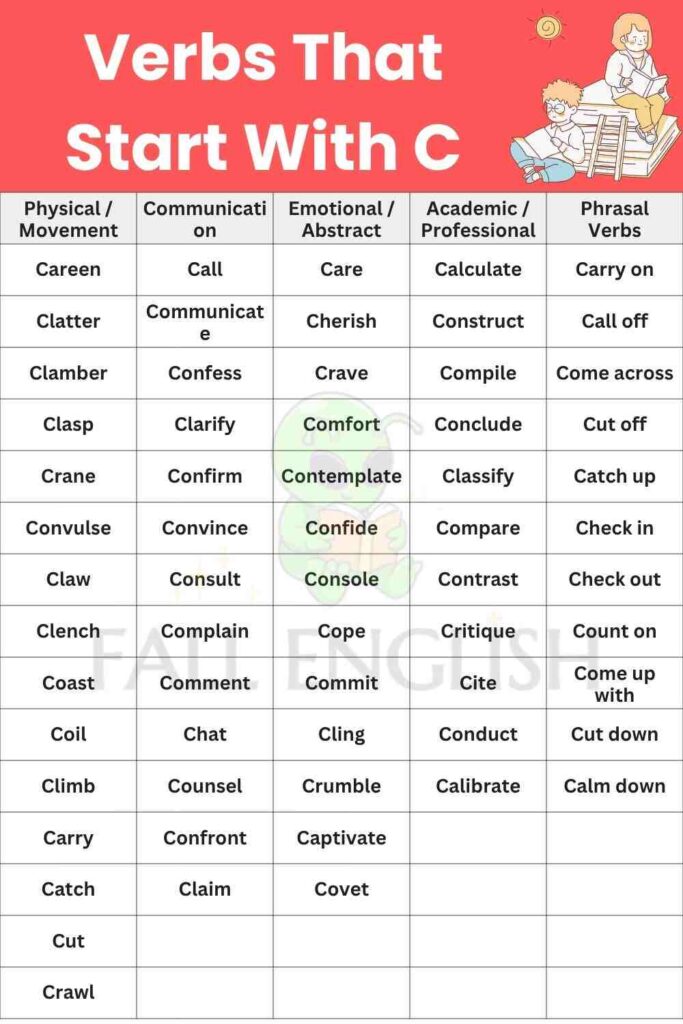
Every verb below appears exactly once across the entire article. This is your complete reference.
Physical / Movement: Careen, Clatter, Clamber, Clasp, Crane, Convulse, Claw, Clench, Coast, Coil, Climb, Carry, Catch, Cut, Crawl, Chase, Clap, Crouch, Crash, Creep, Crack, Crush, Cross, Chew, Curl, Collide, Clutch
Communication: Call, Communicate, Confess, Clarify, Confirm, Convince, Consult, Complain, Comment, Chat, Counsel, Confront, Claim, Correct, Caption, Correspond, Convey, Counter, Concede, Contest
Emotional / Abstract: Care, Cherish, Crave, Comfort, Contemplate, Confide, Console, Cope, Commit, Cling, Crumble, Captivate, Covet, Calm, Concern, Condone, Condemn, Conceal, Coerce
Academic / Professional: Calculate, Construct, Compile, Conclude, Classify, Compare, Contrast, Critique, Cite, Conduct, Calibrate, Certify, Chart, Consolidate, Conceptualize, Contextualize, Characterize, Circulate, Compensate, Comply
Positive / Growth: Create, Cultivate, Contribute, Challenge, Champion, Celebrate, Coach, Cheer, Complete, Collaborate, Change, Choose, Connect
Phrasal Verbs: Carry on, Call off, Come across, Cut off, Catch up, Check in, Check out, Count on, Come up with, Cut down, Calm down, Close in, Cover up
Resume / Business: Coordinate, Controlled, Convert, Configure, Chaired, Championed, Certified, Consolidated, Collaborated, Compiled, Conducted, Created
Tech / Modern: Code, Cloud-source, Copy-paste, Code-switch, Crowdsource, Cross-post, Compress, Cache, Cryptocode, Curate
Word Game / Additional C Verbs (unique to this section): Cap, Cup, Cry, Cue, Cast, Cave, Clip, Club, Coin, Comb, Curb, Craft, Crimp, Croon, Cancel, Charge, Combat, Compel, Canvass, Corroborate, Commercialize, Concentrate, Compromise, Counteract, Correspond, Circulate, Complement, Compliment, Command, Carve, Claim, Captivate (if not listed above), Channel, Cease, Clear, Close, Collect, Color, Come, Cook, Clean, Cover, Copy, Count, Continue, Control
You may like to read:
Qué Tal Meaning — One Phrase, More Than One Life
What Does Ponk Mean? (It Depends on Who Said It)
FAQ’s on Verbs That Start With C
Q: What are the most common verbs that start with C?
The most frequently used C verbs in everyday English are call, come, catch, carry, cut, change, check, choose, create, and control. These appear across speaking, texting, and formal writing every single day.
Q: What are positive verbs that start with C?
The strongest positive C verbs are celebrate, create, cultivate, collaborate, contribute, champion, coach, cheer, complete, and connect. They carry energy, warmth, and direction — ideal for motivational or uplifting content.
Q: What verbs that start with C describe a person?
When writing a character description, reference, or profile, try: cares, coaches, challenges, captivates, communicates, comforts, contributes, collaborates, counsels, and consults. They describe behavior and character, not just action.
Q: What are easy C verbs for kids?
The best beginner C verbs are come, cook, clean, color, count, cover, copy, catch, clap, and call. All are short, simple, and appear in everyday speech.
Q: What verbs start with CA?
There are plenty — call, carry, catch, care, calculate, capture, calm, cancel, cause, carve, cast, cave, careen, calibrate, captivate, and canvass. These are useful for word games, vocabulary building, and spelling practice.
Q: What C verbs work best in creative writing?
For fiction and creative nonfiction, the most powerful C verbs are conceal, confront, crumble, clutch, careen, claw, clench, captivate, confide, and converge. Each one adds texture, tension, or emotional depth that ordinary verbs simply cannot.
Conclusion
C verbs are not just vocabulary items to memorize. They are precision tools. The right one sharpens a resume bullet, brings a fictional scene to life, helps a student write a stronger essay, or helps a beginner build their first real sentences.
The gap between forgettable writing and writing that sticks is almost always the verb.
With 150+ C verbs organized by purpose — not just alphabetical order — this guide gives you what a dictionary never can: context, comparison, and the confidence to choose well.
Pick the verb that carries exactly the weight you need. Nothing more. Nothing less.

FallEnglish is run by a language enthusiast who explains word and text meanings in clear, simple ways. Each guide is carefully researched, original, and written to help real people understand language faster, with accuracy, context, and everyday examples you can trust.